.svg)
Sex-based misconduct remains one of the most frequently reported civil rights violations in New York employment settings. Even so, many victims struggle to determine how the law classifies what happened to them, which legal path applies, and how quickly action must be taken. Confusion between sexual assault and sexual harassment often results in delayed reporting, missed deadlines, or filing claims in the wrong forum.
Sakkas, Cahn & Weiss, LLP represents individuals throughout New York in civil matters involving sexual assault, sexual harassment, and related forms of sexual misconduct. Our practice focuses on pursuing accountability through civil litigation, including claims against perpetrators, employers, property owners, and institutions that failed to prevent or address abuse.
Victims of workplace-related misconduct may benefit from speaking with our experienced New York City sexual harassment lawyers, who handle complex claims under New York law and federal statutes.
What Sexual Assault Means in New York

Sexual assault refers to physical acts involving sexual contact or sexual activity without consent. These offenses are addressed under New York Penal Law Article 130.
Sexual assault refers to conduct such as:
- Unwanted touching of intimate body parts
- Forced sexual acts
- Attempted rape
- Sexual contact involving intoxication or incapacity
- Sexual abuse committed by a family member or authority figure
New York Law treats consent in a strict manner. Silence, fear, intoxication, pressure, or power imbalance may eliminate consent even when no weapon or overt force is used. Sexual assault cases may proceed in criminal court, civil court, or both. Criminal cases focus on punishment, while civil lawsuits allow victims to pursue monetary compensation for physical, emotional, and financial harm.
What Sexual Harassment Means in New York
Sexual harassment involves unwanted behavior of a sexual nature that creates an offensive environment or conditions benefits on sexual favors. Physical contact is not required.
Sexual harassment includes:
- Unwelcome sexual advances
- Sexual comments or lewd remarks
- Sexual gestures
- Requests for sexual favors tied to a pay raise or promotion
- Repeated unwanted behavior of a sexual nature
Sexual harassment is prohibited under:
- New York State Human Rights Law (NYSHRL)
- New York City Human Rights Law (NYC Administrative Code § 8-107)
These laws apply broadly to workplaces, housing, schools, and public accommodations, and they impose liability on both individuals and institutions. Sexual misconduct can happen to anyone, regardless of gender, age, sexual orientation, or cultural background.
Real-World Examples of Sexual Assault and Sexual Harassment in New York
New York courts and enforcement agencies evaluate sexual misconduct by examining the nature of the conduct, consent, physical contact, and power dynamics.
Examples of Sexual Assault

Sexual assault involves physical conduct and a lack of consent. These acts are considered criminal offenses under New York law and may also support a civil lawsuit.
Examples include:
- Unwanted touching of someone’s body, including intimate areas, without consent.
- Forced sexual acts involving physical force, threats, or coercion.
- Sexual contact occurring when a person is unconscious, intoxicated, or otherwise unable to consent.
- Attempted rape, even when the sexual act is not completed.
- Sexual abuse committed by a family member, caregiver, or authority figure.
- Sexual activity obtained through fear, pressure, or abuse of power.
Such conduct may result in arrest, prosecution, and civil liability.
Examples of Sexual Harassment
Sexual harassment involves unwanted behavior of a sexual nature that affects employment, housing, education, or access to services. Physical contact is not required.
Examples include:
- Unwelcome sexual advances by a supervisor, coworker, landlord, or educator.
- Requests for sexual favors in exchange for a pay raise, promotion, housing benefits, or continued employment (quid pro quo harassment).
- Repeated sexual comments, lewd remarks, or sexually explicit jokes.
- Sexual gestures or sexually explicit messages sent through email, text, or workplace systems.
- Persistent unwanted behavior after rejection.
- Creating or allowing an offensive environment through ongoing sexual conduct.
These claims are commonly addressed through civil lawsuits or administrative agency filings rather than criminal prosecution.
Sexual Assault vs. Sexual Harassment: Key Differences
Although both involve sex-based misconduct, New York law treats sexual assault and sexual harassment as legally distinct claims. The classification affects where a case is filed, the required proof, and the time a survivor has to act.
Below is a table with a quick comparison:
This distinction is critical. Misclassifying a claim can lead to filing in the wrong forum or missing a deadline entirely, particularly in workplace cases handled by New York City sexual harassment lawyers.
Penalties and Legal Consequences
New York significantly expanded survivor rights under CPLR § 214-g (Adult Survivors Act) through legislative reform, recognizing that many victims delay reporting for valid reasons. Sexual assault penalties may include:
- Felony or misdemeanor convictions
- Prison sentences
- Sex offender registration
- Civil damages for medical costs, pain, and lost wages
Under the Child Victims Act (CVA), survivors of childhood sexual abuse can file civil lawsuits until age 55, providing a longer time period to seek justice.
Sexual harassment consequences may include:
- Monetary compensation
- Back pay and lost wages
- Emotional distress damages
- Civil penalties against employers or institutions
Abuse by medical professionals or clergy often involves hidden power imbalances, making civil accountability essential even years after the misconduct occurred.
Sexual harassment claims generally follow much shorter deadlines, particularly when agency filings are required. Missing these deadlines often eliminates the claim entirely, regardless of its strength.
What to Do After Experiencing Sexual Assault or Sexual Harassment in NY
After sexual assault or sexual harassment occurs, victims often face pressure from employers, institutions, family members, or the perpetrator to remain silent or “handle it internally.” These early moments frequently shape the legal outcome, even when a lawsuit is filed much later.
In New York, no single step applies to every case, but certain actions consistently preserve legal rights. Common steps include:
- Seeking medical care after unwanted physical contact or sexual activity, even if injuries are not visible.
- Preserving clothing, bedding, or personal items that may contain physical evidence.
- Saving text messages, emails, social media messages, and workplace communication.
- Writing down dates, locations, witnesses, and changes in behavior or treatment.
- Avoiding internal complaints or settlement discussions before legal review.
Many survivors delay action due to fear, shame, or uncertainty. New York law recognizes this reality and allows extended time periods in many sexual abuse cases, but early documentation often determines how much evidence remains available later.
How Sexual Assault and Harassment Can Affect Victims Long After the Incident
Sexual assault and sexual harassment often create harm that extends far beyond the incident itself. The legal system frequently addresses not only the misconduct but also the damage caused by silence, retaliation, and institutional failure.
Common long-term consequences include:
- Psychological trauma, anxiety, and sleep disruption.
- Loss of income, job opportunities, or professional advancement.
- Pressure to maintain contact with the perpetrator.
- Retaliation or subtle punishment in the workplace.
- Isolation from coworkers, family members, or community support.
In harassment cases, employers sometimes attempt to reframe abuse as a “miscommunication” or “personality conflict.” In assault cases, victims may face disbelief or scrutiny when reporting long after the event. These dynamics often become central issues in civil litigation, especially when an organization failed to act despite prior complaints or warning signs.
How to Get Help, Support, and Sue the Perpetrator

Legal action is only one part of recovery, but it plays a critical role in accountability. In New York, survivors may simultaneously pursue both support services and civil remedies.
Available support may include:
- Medical providers and trauma-informed therapists
- Sexual assault advocacy organizations
- Crisis hotlines and survivor networks
- Civil rights and personal injury attorneys
From a legal standpoint, civil lawsuits may be brought against:
- The individual who committed the assault or harassment.
- Employers who allowed abuse or failed to intervene.
- Property owners, schools, or institutions that ignored complaints.
- Organizations that retaliated against a victim for reporting misconduct.
Civil courts allow survivors to seek monetary compensation for medical expenses, therapy, lost wages, emotional distress, and long-term harm. In many cases, institutional liability becomes more significant than the conduct of a single person.
When to File with an Agency Versus Going Straight to Court
Agency filings are subject to strict deadlines, sometimes as short as 300 days, and may limit the ability to pursue certain claims in civil court later. Sexual harassment claims often begin with an administrative filing through:
- Equal Employment Opportunity Commission (EEOC)
- New York State Division of Human Rights
- New York City Commission on Human Rights
Sexual assault cases, particularly those involving unwanted physical contact, sexual abuse, or attempted rape, often proceed directly to civil court. Criminal prosecution may occur separately and is handled by local authorities, not the victim.
The correct filing path depends on:
- Whether physical contact occurred
- Whether the conduct arose in a workplace or institutional setting
- The age of the victim at the time of the abuse
- Applicable statutes of limitations
An incorrect filing choice can permanently foreclose stronger legal claims.
What Evidence Matters Most in Sexual Assault and Harassment Cases
Evidence in sexual misconduct cases often exists before victims recognize its legal significance. Courts and agencies assess both direct proof and circumstantial patterns.
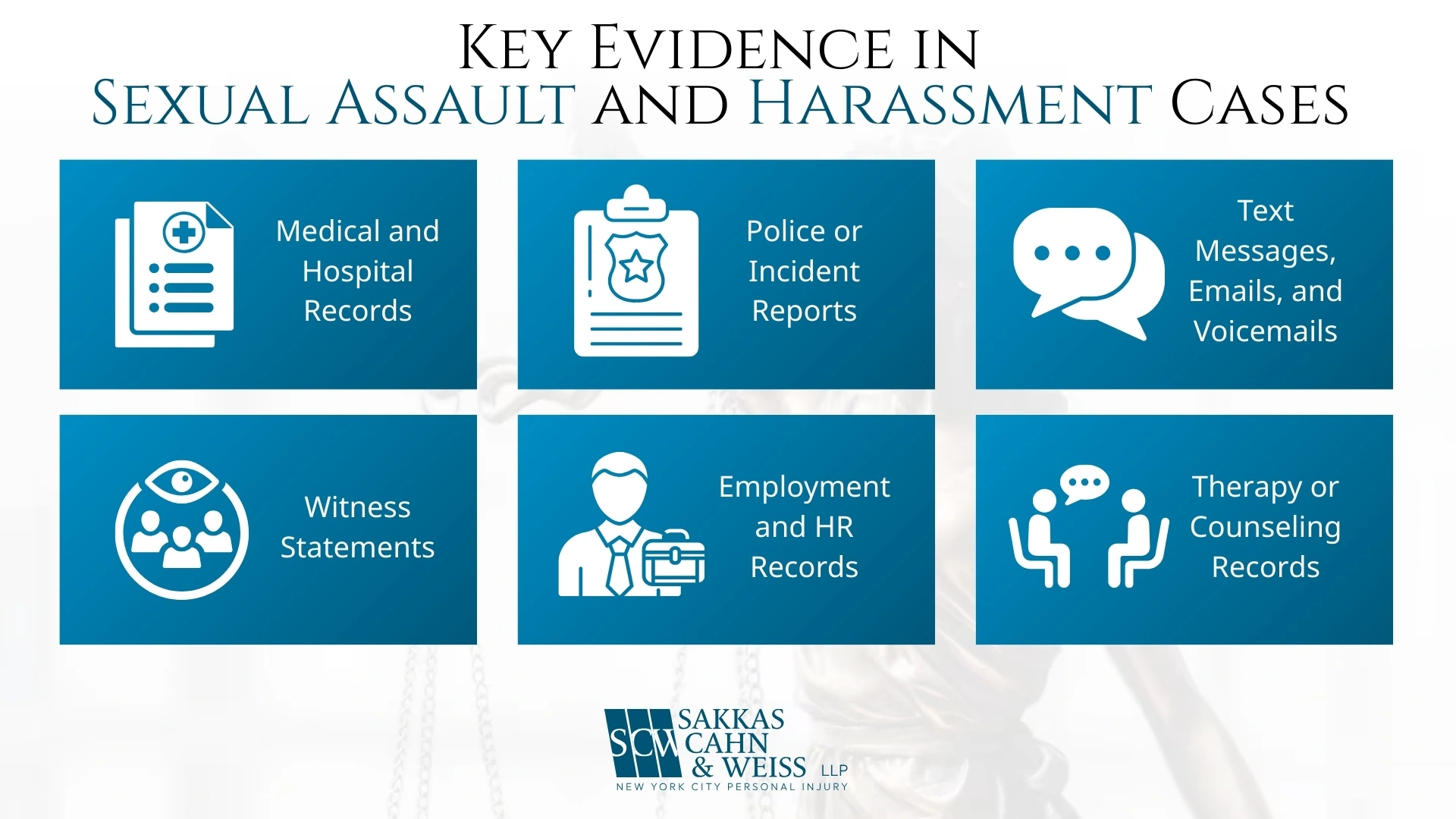
Common forms of evidence include:
- Medical and hospital records
- Police reports or incident reports
- Text messages, emails, voicemails, and internal communications
- Witness statements from coworkers, classmates, or family members
- Employment records, performance reviews, or HR complaints
- Therapy and counseling records documenting the emotional impact
Evidence preservation matters even when no lawsuit is filed immediately. Deleted messages, overwritten phone data, and lost records frequently weaken otherwise credible claims.
Common Early Mistakes That Weaken Sexual Assault and Harassment Claims
Many survivors unintentionally damage their own cases during the early stages, often due to pressure or misinformation.
Common mistakes include:
- Waiting too long to document events or seek advice.
- Reporting only internally and relying on employer investigations.
- Posting details publicly on social media.
- Accepting informal settlements or nondisclosure agreements.
- Missing agency or court filing deadlines.
These errors do not invalidate the harm suffered, but they can limit available remedies and reduce leverage during litigation.
Your Legal Rights After Sexual Assault or Sexual Harassment
Sexual assault and sexual harassment cases require careful classification, strict attention to deadlines, and a litigation strategy built around preserved evidence. Errors made early in the process can permanently restrict legal options, even when misconduct is clear.
Sakkas, Cahn & Weiss, LLP represents survivors across New York in civil sexual assault and sexual harassment cases. Our attorneys handle claims involving physical assault, workplace misconduct, institutional failure, and long-term abuse. Contact us today.


Does Your Situation Qualify as Sexual Assault or Sexual Harassment?
New York law treats physical sexual contact and workplace misconduct differently. Our team of attorneys can clarify how your experience is classified and which laws apply — reach out.
.webp)