



Feb 06, 2026
Blinking traffic lights change how an intersection works. In New York, that change is not subtle. Urban areas like New York City present unique challenges for vehicular traffic at intersections with blinking lights. When a signal switches to blinking mode, the city stops directing traffic for you. Drivers must assess the situation, yield appropriately, and proceed only when conditions permit. Many crashes happen because drivers treat blinking lights as relaxed versions of normal signals, which they are not.
In this blog post, we break down what blinking traffic lights mean at New York intersections and how drivers are expected to respond. Our New York City car accident lawyers regularly handle crashes caused by confusion at intersections, missed signals, and failure to yield. Understanding these rules can help reduce collision risk, improve traffic flow in dense urban areas, and protect everyone on the road.
How Traffic Lights Normally Control Intersections in New York
Most New York drivers rely on signal timing without thinking about it. Green means go. Yellow indicates a stop ahead and to slow down, and red requires a full stop. The light decides who moves and who waits. Once the lights begin blinking, that system no longer applies.
At a blinking intersection, the signal no longer assigns turns; it assigns responsibility. Drivers must look, judge distance and speed, and yield correctly. When that judgment fails, intersections turn dangerous very quickly.
What Does a Blinking Light Mean at a New York City Intersection
While the general rules for blinking lights apply throughout New York State, there are some specific considerations for drivers in New York City due to its unique urban environment and high traffic density.
Increased caution in high-density areas
In New York City, a blinking light at an intersection often requires even greater caution due to:
- Higher pedestrian traffic: NYC is known for its walkability, so drivers must be extra vigilant for pedestrians when encountering blinking lights.
- Increased bicycle presence: With the city’s extensive bike lane network, cyclists may be crossing intersections from various directions.
- Complex intersections: Many NYC intersections involve multiple streets converging, making navigation more challenging when signals are in blinking mode.
In New York City, these conditions make yielding errors more likely and fault disputes more common after a crash. Motorists should always observe the posted speed limit when approaching intersections with blinking lights.
Yellow Blinking Lights at New York Intersections
A yellow blinking light does not require a stop, but it also does not clear the intersection. Traffic may continue only after yielding, as required under New York Vehicle and Traffic Law §1142.
At a yellow blinking light, drivers must:
- Slow down before entering the intersection.
- Scan all lanes and crosswalks.
- Watch for cyclists approaching from any direction.
Many drivers maintain speed, assuming cross traffic will wait. At many intersections, the crossing street faces blinking red signals, allowing those drivers to enter after stopping.
Pedestrian signals often remain active while vehicle lights blink. Movement through the intersection is permitted only after yielding to all other road users.
Red Blinking Lights at New York Intersections
A red blinking light requires a full stop at the stop line or, if none exists, at the point nearest the intersection with a clear view of traffic. Under New York Vehicle and Traffic Law §1114, blinking red lights function the same way as stop signs.
Drivers must:
- Stop completely
- Check all directions
- Yield before proceeding
Many crashes at these intersections involve rolling stops. Because blinking red signals are highly visible, failure to stop is often central when fault is reviewed after a crash.
Why Drivers Confuse Solid and Blinking Signals
Solid lights manage traffic for drivers. Blinking lights do not. That difference creates confusion.
Drivers expect signals to automatically assign turns. Blinking lights remove that structure. A yellow blinking light does not replace a green light, and a red blinking light does not replace a full traffic cycle. Each color carries a separate rule. Drivers who rely on habit rather than observation often enter intersections without realizing that the rules have changed.
What New York Tries to Accomplish with Blinking Lights
New York transportation authorities use red and yellow blinking lights at intersections for several reasons:
- To indicate a transition period: Sometimes, traffic lights are switched to blinking mode during late-night hours when traffic is light. This allows for more efficient traffic flow while still maintaining safety.
- To alert drivers to potential hazards: Blinking lights at an intersection mean there may be unique conditions that require extra caution, such as a blind curve, a high-accident area, or an unusual intersection layout.
- To manage traffic flow: In some cases, yellow blinking lights are used on major roads intersecting with minor roads (which would have red blinking lights). This allows traffic on the main road to flow more freely while still requiring caution.
- During malfunctions: If a traffic signal is malfunctioning, it may default to blinking mode. In this case, drivers should treat a yellow blinking light as a yield sign and a red blinking light as a stop sign.
Because blinking lights remove structure, drivers must actively yield and stop correctly — failure to do so often leads to side-impact crashes.
Common Misunderstandings About Red and Yellow Blinking Lights in New York
Despite their intended purpose, red and yellow blinking lights can sometimes lead to confusion among New York drivers. Here are some common misunderstandings:
- Assuming right of way with a yellow blinking light: Some drivers mistakenly believe that a yellow blinking light gives them the right of way. Remember, a yellow blinking light at an intersection means you must yield to other traffic and pedestrians.
- Treating a yellow blinking light like a green light: While you don’t have to stop at a yellow blinking light if the way is clear, it’s not the same as a green light. You must approach with caution and be prepared to yield.
- Rolling through a red blinking light: A red blinking light requires a full stop, just like a stop sign. Rolling through without stopping is a traffic violation in New York.
- Confusion between yellow and red blinking lights: Drivers must be able to distinguish between yellow and red blinking lights, as they require different responses.
Drivers who pause to assess traffic avoid many of the conflicts caused by assumption-based decisions.
Which Traffic Rules Control Your Crash?
Right-of-way, signal phases, and driver conduct all play a role. Our attorneys explain how those factors shape your case — reach out today.

Accidents That Often Happen at Blinking-Light Intersections
Side-impact crashes dominate blinking-light intersections. One driver enters assuming priority. Another enters assuming the same. The collision happens in the center of the intersection:
- T-bone collisions: Also known as side-impact crashes, these occur when the front of one vehicle strikes the side of another.
- Rear-end collisions: These happen when a vehicle crashes into the one in front of it, often due to sudden stops or tailgating.
- Left-turn accidents: Occur when a vehicle making a left turn collides with oncoming traffic or pedestrians.
- Right-turn accidents: Involve vehicles turning right and colliding with pedestrians, cyclists, or other vehicles.
- Head-on collisions: Rare but severe; these happen when vehicles traveling in opposite directions crash front-to-front.
- Sideswipe accidents: Occur when the sides of two parallel vehicles make contact, often while changing lanes or merging.
- Multi-vehicle pile-ups: Complex accidents involving three or more vehicles, often triggered by an initial two-vehicle collision.
- Pedestrian and cyclist accident: Collisions between vehicles and pedestrians or cyclists crossing the intersection.
- Fixed-object collisions: Vehicles crash into stationary objects at intersections, such as traffic lights, signs, or barriers.
Each type of accident can result in different injury patterns and legal implications.
Why Intersection Crashes Are so Common in New York
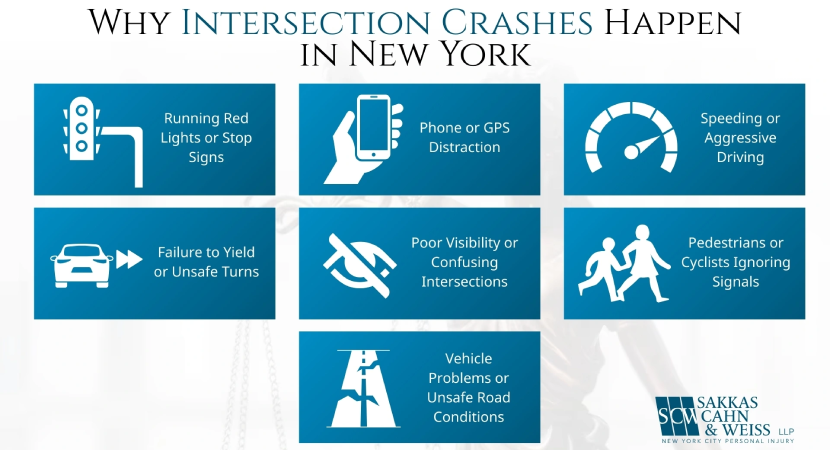
Intersections are hotspots for traffic accidents in New York. New York intersections concentrate traffic, pedestrians, cyclists, and delivery vehicles into tight spaces. Here are the primary factors leading to intersection accidents in New York:
- Failure to obey traffic signals: Running red lights, ignoring stop signs, or misinterpreting blinking lights.
- Distracted driving: Using phones, adjusting GPS, or engaging in other activities that take attention away from the road.
- Speeding: Reducing reaction time and ability to stop safely at intersections.
- Impaired driving: Operating vehicles under the influence of alcohol or drugs, impairing judgment and reaction times.
- Aggressive driving: Tailgating, weaving through traffic, or rushing to beat yellow lights.
- Failure to yield right-of-way: Not giving way when required, especially during left turns or when merging.
- Poor visibility: Weather conditions, inadequate lighting, or obstructed views affecting driver sight lines.
- Confusion at complex intersections: Hesitation or improper maneuvers at multi-way or unusually designed intersections.
- Pedestrian and cyclist errors: Crossing against signals or entering intersections without looking.
- Vehicle malfunctions: Brake failures, tire blowouts, or steering issues contributing to accidents.
- Poor road conditions: Potholes, unclear lane markings, or malfunctioning traffic signals.
- Improper turns: Making illegal U-turns or turning from the wrong lane.
- Fatigue: Slower reaction times and poor decision-making, especially during late hours.
- Inexperienced drivers: Lack of skills to navigate complex intersections safely.
- Following too closely: Reducing time to react to sudden stops or changes in traffic flow.
These intersections generate higher crash rates not because the signals are unclear, but because they rely on driver judgment instead of timed control. When multiple drivers claim priority simultaneously, conflicts arise.
How Fault Is Determined After a Blinking-Light Crash
New York applies pure comparative negligence under New York CPLR §1411. Fault can be divided between drivers, pedestrians, or multiple parties.
Investigations focus on:
- Whether drivers stopped when required.
- Whether yielding rules were followed.
- Vehicle positions and speeds.
- Witness statements and footage.
Drivers who fail to stop at blinking red lights or fail to yield at blinking yellow lights often bear significant fault.
Your legal options:
- Insurance claims: Filing a claim with the at-fault driver’s insurance company is often the first step.
- No-fault benefits: New York is a no-fault state, meaning your own insurance will cover some medical expenses and lost wages, regardless of who was at fault.
- Personal injury lawsuit: If your injuries meet New York’s “serious injury” threshold, you may be able to file a lawsuit against the at-fault party.
- Statute of limitations: In New York, you generally have three years from the accident date to file a personal injury lawsuit.
In New York, you generally have three years from the accident date to file a personal injury lawsuit under New York CPLR §214. Investigators reconstruct how each driver responded to the signal, how the intersection functioned at that time, and whether traffic rules were followed in sequence. Small details often shape how responsibility is ultimately assigned.
What to Do After a Crash at a New York Intersection
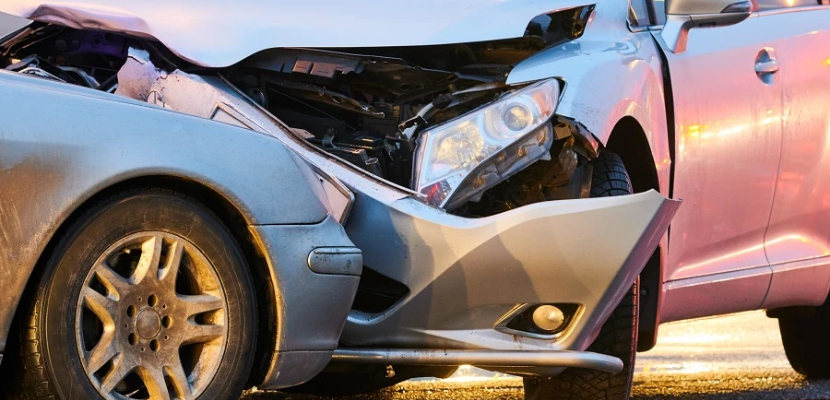
Crashes at intersections tend to leave people shaken and unsure of what just happened. When blinking lights are involved, confusion is common because drivers often realize only afterward that the rules were different from what they assumed.
- Check people first, then the roadway: Look for injuries before anything else. If vehicles can be moved without risk, getting out of active lanes reduces the chance of a secondary collision — something that happens often at busy New York intersections.
- Call 911, even if the damage appears minor: Police documentation is essential when signal patterns and right-of-way questions arise later. Medical help should be requested whenever pain, dizziness, or shock is present.
- Capture the intersection exactly as it looks: Take photos of the blinking lights, lane layout, crosswalks, and where each vehicle came to rest. Signals may return to normal operation within minutes, and that change can erase key context.
- Keep conversations brief and factual: Explanations offered at the scene often reflect confusion rather than reality. Avoid statements about fault or guesses about who had priority. Those details are reviewed later using evidence.
- Get legal input before positions harden: Blinking-light crashes frequently turn on small details. Early review helps sort out those details while the information is still fresh.
After an intersection crash, the street may look ordinary once traffic clears, but the decisions made in the first hour carry weight long after. Clear photos, restrained statements, and timely review help preserve what actually happened before assumptions replace facts.
Get Legal Help for Your New York Intersection Accident Case
An intersection crash can leave questions about fault, signals, and next steps. When injuries are involved, those questions carry real consequences. Sakkas, Cahn & Weiss, LLP reviews intersection accident cases across New York with a focus on how traffic rules are applied and where responsibility falls. Contact us today for a free consultation. Let our dedicated team use our advanced knowledge and skills to win you maximum compensation.